
Public relations has long been seen as an essential component to a brand's success, but more often than not it can be difficult to quantify. Organizations rely on PR to build trust, reputation, and awareness; yet these are much harder to pin down than marketing leads or pure sales numbers.
For PR professionals, a major challenge lies in proving to C-suite executives, clients, and key stakeholders that communications activities aren’t just “nice to have,” but critical to driving business results.
In fact, Cision’s Inside PR Report, a survey of over 500 PR and comms professionals, revealed that 49% of respondents named measurement and ROI as one of their top priorities for 2026. With this in mind, let’s explore six tips to help effectively demonstrate the true value of PR to your stakeholders.
1. Tie your PR goals directly to business objectives
Your stakeholders care about outcomes, not just outputs. Instead of focusing on boosting brand mentions or shifting sentiment, can you find a way to link your strategic PR targets into wider business goals? For example, your organization might prioritize the following:
- Increasing brand awareness in target markets
- Supporting product launches and driving demand
- Enhancing reputation and trust within key communities
- Mitigating risks during times of crisis
What does this look like in practice? If your company’s goal is market expansion, can you demonstrate how your PR efforts helped win media coverage across different regional outlets (and greater visibility among potential customers)?
By connecting your communications work to strategi objectives, you’ll ensure PR is viewed as much more than just an isolated business function.
2. Choose the metrics that matter to leadership
Traditional vanity metrics like AVE (advertising value equivalency) don’t tell the full story. There are more meaningful public relations-focused guides such as the Barcelona Principles, a globally recognized framework that emphasizes tying your metrics to goal setting.
Consult with your stakeholders and C-suite early to establish what metrics will best demonstrate impact. The three below are a good place to begin – and can easily be measured over time to benchmark progress:
- Share of voice: Track how your brand compares to competitors and how that share shifts to coincide with earned media coverage.
- Brand sentiment: Monitor the sentiment – positive, negative, or neutral – behind coverage of your brand and see if changes coincide with your PR efforts.
- Audience engagement: Track the number of social shares, comments, and interactions around your PR campaigns across owned channels.
Combining these metrics with qualitative insights – think stakeholder feedback and customer surveys – will give you a more holistic view of how your PR efforts are landing.
3. Show PR’s role in managing reputation and risk
Two of the core functions of public relations are to protect brand reputation and manage risk and crises. These areas are difficult to put a price tag on but deeply important to stakeholders and a brand’s ongoing success.
Here are two clear examples of how PR professionals can tackle these challenges:
- Proactive media monitoring and social listening can help your team identify and address any issues before they escalate and potentially dent brand reputation.
- Show brand sentiment shifting from negative to neutral during a crisis to demonstrate how your clear, consistent messaging minimized the spread of negative news stories.
Though PR is often framed as a growth driver for brands, it’s also key to recognize its role in safeguarding reputation – something that resonates with the C-suite, employees, and customers.
4. Leverage case studies and real-life examples
Numbers alone don’t paint a complete picture; it’s stories that stick in people’s minds. Any metrics you bring to the table will have a greater impact if they are framed within a compelling narrative.
This is where you can use case studies and your own storytelling (a priority PR skill for 2026, according to the Inside PR Report) to your advantage.
For example, if your media outreach campaign for a new software product launch resulted in 200 demo requests, unpack that and explain how your work with journalists contributed to that success.
A topline statement could say: “Our targeted media outreach campaign to a curated list of tech-focused reporters secured 15 top-tier placements in outlets including The Verge and Wired, driving a 30% spike in traffic to the product page and generating 200 demo requests within the first two weeks of launch.”
When your brand’s stakeholders can see both the data and the narrative behind it, the value of PR becomes much more evident.
5. Speak ROI, not reach to the C-suite
Executives have long moved beyond press clipping scrapbooks. Moreover, they don’t live and breathe PR the way you do, so they aren’t familiar with the terms and language you use day to day.
However, what they do want to understand is how PR can move the needle for an organization financially. When reporting, tie your activities back to the business in terms of:
- Revenue: Have your PR campaigns supported growth in the sales pipeline?
- Cost savings: Has effective crisis communications prevented monetary loss to the organization?
- Risk management: Have you managed to mitigate any risks to the brand by acting quickly through media monitoring insight?
- Reputation management: Have you maintained (or improved) brand sentiment over time, helping to enhance perception in the market?
By translating these metrics into tangible business results you’ll be able to ensure that PR’s value remains understood across the entire organization.
6. Use PR technology and tools to strengthen reporting
Your PR tech stack can help you unlock value for your team, organization, and customers. Adding a media intelligence platform like CisionOne makes it easier to show the value of your PR team. For example, the Ontario College of Social Workers and Social Service Workers use CisionOne to track key themes related to their sector – including social work, healthcare, and public trust – then turn this coverage into internal summaries to keep internal teams aligned and prepared to respond.
The right tools will let you dig deeper into brand mentions, audience reach, movements in sentiment and share of voice – all in real time as you monitor the direct and indirect benefits of PR campaigns.
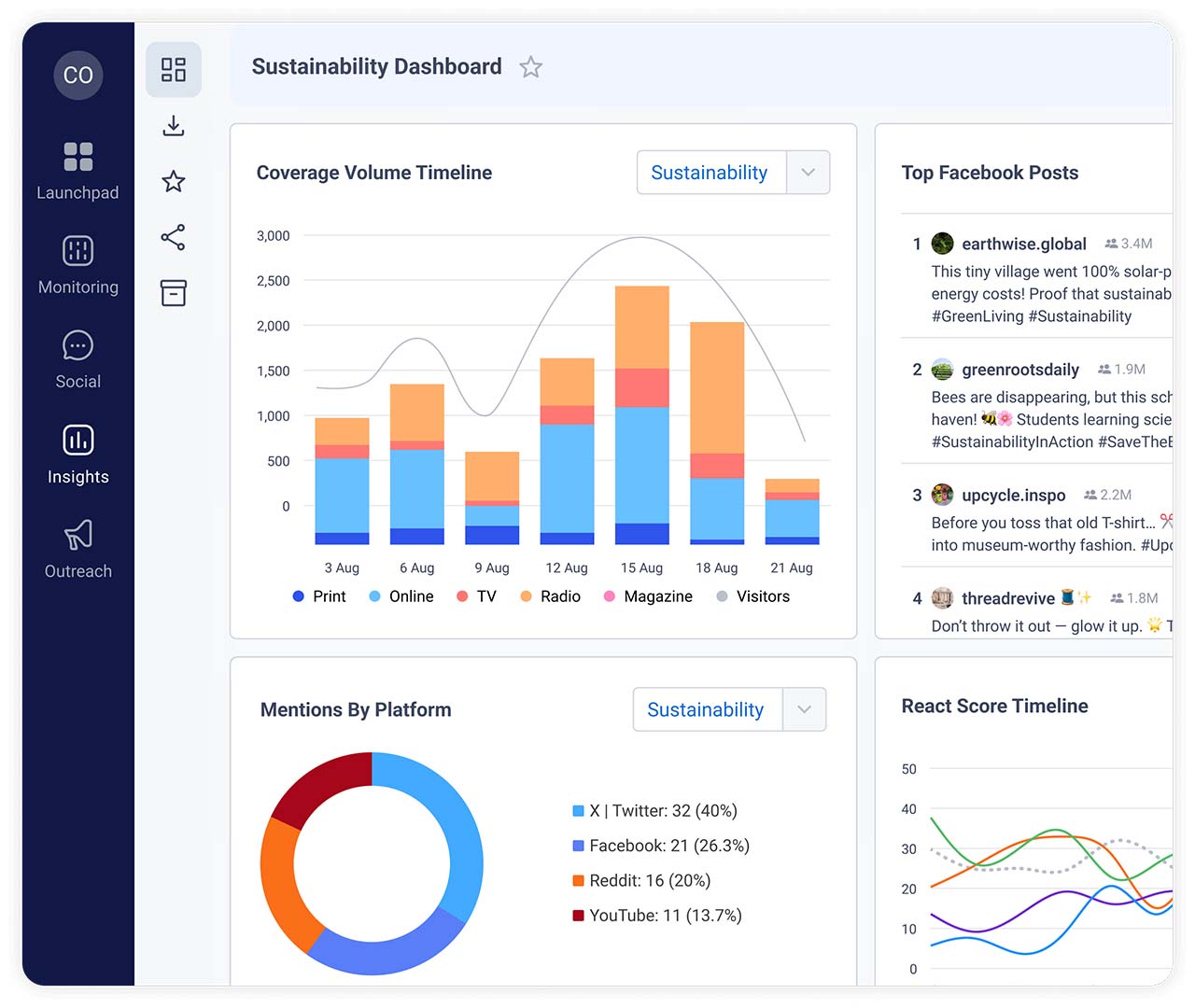
These platforms also offer scope to build automated dashboards and visual reports, meaning any relevant stakeholders can stay up to speed with where their brand sits in the media conversation. The result? Complex metrics and data become insights that can be acted upon quickly.
The bottom line
Proving the value of PR requires much more than just reporting coverage numbers or counting brand mentions. It’s a blend of quantitative and qualitative information, showing that your comms work is building trust, shaping reputation for the better, and driving measurable business results.
By aligning PR activities with organizational goals, using robust metrics, and communicating in terms stakeholders care about, teams can secure stronger buy-in, and earn a seat at the decision-making table.
Find out how CisionOne can help you prove PR impact to C-suite leaders and key stakeholders.
Most Recent Posts
Cision Resources
-
E-books and Guides
Comprehensive how-to guides on strategy and tactics
-
Case Studies
What are other brands doing – and how can we learn from them?

About Simon Reynolds
Simon is the Senior Content Marketing Manager at Cision. He worked as a journalist for more than a decade, writing on staff and freelance for Hearst, Dennis, Future and Autovia titles before joining Cision in 2022.