
In 2026, PR professionals will face ongoing challenges around technology and the continued rise of AI, stretched resources, and a noisy media environment driven by social platforms and the rise of independent media outlets.
With everything on their plate, teams need to be agile and focused on honing the public relations skills that will give them an edge, blending PR fundamentals with emerging tools and tech capabilities. Cision’s Inside PR 2026 Report, created from a survey of nearly 600 public relations professionals, sheds like on where the industry stands today, where it's going, and what success will look like in the year ahead – including the most in-demand skills and how to leverage them for success.
Read on to uncover some of the key findings – then download the report for more essential PR insight.
What skills do you need for PR in 2026?
For our Inside PR 2026 Report survey, we asked respondents to tell us the skills they view as essential over the next 12 months. The results below demonstrate just how multifaceted and flexible today’s PR pros need to be to succeed in 2026 and beyond.
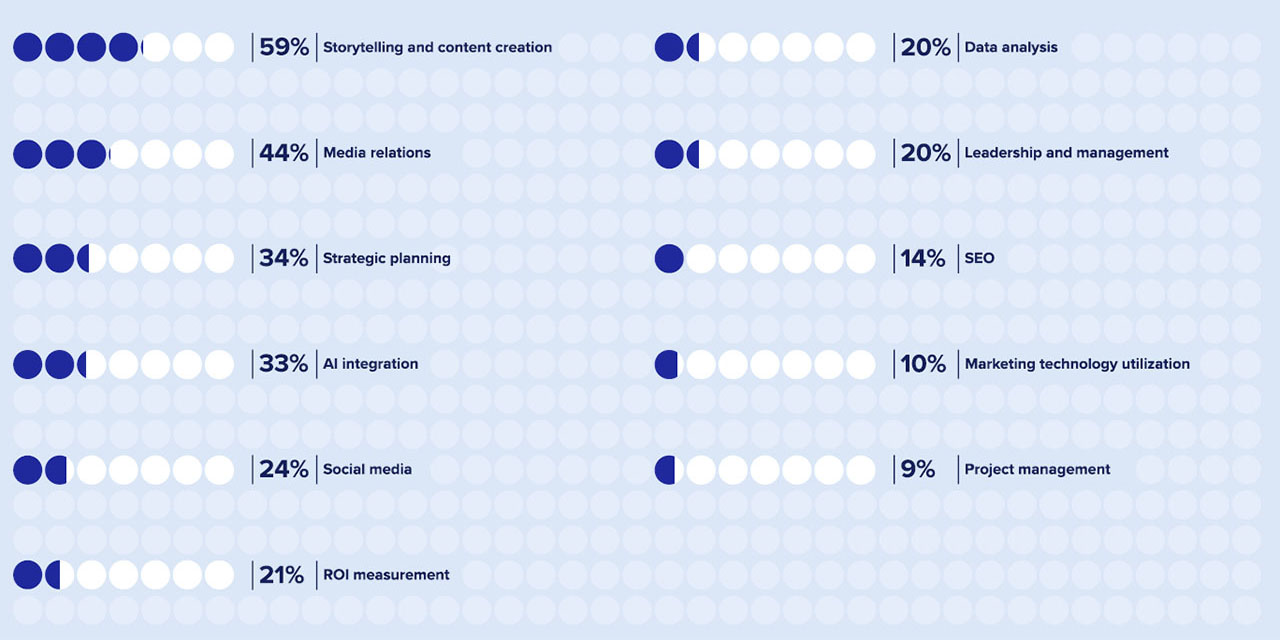
Chosen by 59% of respondents, storytelling and content creation sits at the top of the list of most valuable PR skills, cementing the fact that compelling narratives remain the foundation of effective public relations.
Media relations follow at 44%, showing that building and maintaining journalist and influencer connections is still an essential public relations skill.
Strategic planning sits in third place at 34%, reflecting the industry's shift toward business-aligned communications. PR professionals now need to develop comprehensive strategies that can support an organization’s overall goals and ambitions.
AI integration ranks fourth as a desired skill with 33%. AI literacy is no longer a nice-to-have, but a must-have competency. PR pros are now expected to fully understand how AI can be deployed across their teams, be that through content creation or boosting efficiency across their workflows.
Social media skills claim 25% of responses, underscoring that these skills are critical for modern communicators as they navigate a fragmented media landscape with more ways to reach audiences – and more competition for audience attention – than ever before.
The growing need for PR teams to demonstrate the value of their work is evident in the prominence of ROI measurement (21%) and data analysis (20%) as answer selections. As budgets tighten and teams face increased scrutiny, the ability to demonstrate tangible business impact has become central to public relations expertise.
Supporting skills such as leadership and management (20%), SEO (14%), market technology utilization (10%), and project management (9%) complete the list.
PR skills + 2026’s biggest challenges
The PR skills teams see as most valuable are directly linked to the hurdles they face – another key aspect of our research. These Inside PR 2026 Report stats around the challenges the industry faces can inform how to approach them – and where to potentially prioritize efforts for the year ahead.
The challenge: Teams are now expected to do more with tighter budgets and reduced staff numbers – and the data reflects it. Resource pressures ranked as the number one challenge overall, cited by 34% of respondents.
The skills solution: AI integration and marketing technology skills are particularly valuable, offering ways for PR pros to automate routine tasks and boost their productivity. Strategic planning also becomes key when PR campaigns need to show clear ROI with limited resources.
The challenge: The changing media landscape (named by 21%) demands a greater understanding of new media platforms and evolved media relations skills.
The skills solution: PR pros need social media expertise and adaptable media relations skills to navigate relationships with journalists, independent creators, and influencers. Effective storytelling across diverse formats and platforms is essential to identify and engage with the right voices to fit a given story.
The challenge: AI and automation adoption emerged as another big challenge for next year, cited by 18% of respondents.
The skills solution: For all of its perceived challenges, 48% also recognize AI as a huge opportunity for its ability to drive efficiency and insights. PR pros who can leverage AI in everything from media monitoring to content creation and data analysis will emerge ahead. (The key is balancing these cutting-edge tech capabilities with creative judgment to amplify rather than replace the human-led approach that defines great PR.)
The challenge: More than 1 in 10 PR professionals struggle with creating data-driven strategies, highlighting the growing need for pros to hone their ROI measurement and data analysis capabilities.
The skills solution: PR teams that can turn metrics into actionable insights will be well positioned to demonstrate their value and secure future resources. This means investing in data fluency – learning how to use measurement platforms effectively, tie communications activities to business objectives, and translate performance data into C-suite friendly reporting that prove PR's bottom-line impact.
The challenge: Misinformation and disinformation risks complete the list of the top ranked challenges PR teams face, which is particularly unique as even the most well-established brands can find themselves at the center of false narratives.
The skills solution: To navigate this challenge, PR teams need strong media monitoring and social listening capabilities to detect false narratives early, rapid fact-checking and verification skills to assess risk quickly, and crisis response expertise to act decisively.
How to build PR skills
Developing your skills requires effort and a commitment to keep learning. If you're seeking employer support, frame your learning as an investment to help directly address the challenges your business faces.
PR might be constantly busy and resource-stretched, but here’s some good news – there are many resources and pathways (a lot of them free) to help expand your knowledge and sharpen your skill set. Here are a few ideas to get started:
- Invest in learning & development: Online learning platforms like Udemy and Coursera offer free PR-specific courses, as well as programs that cater to specific skills like AI and data analysis. If your organization has a LinkedIn Premium business plan (or you have one individually), you’ll have access to LinkedIn Learning, which offers thousands of courses to help sharpen your skills. The advantage of online courses is that you’re able to tackle them at your own pace, and target the areas you feel you need the most development.
- Make the most of webinars: Webinars provide opportunities to stay up to date on evolving media skills and industry trends. PR technology companies like Cision and industry associations like PRSA, PRWeek, and CIPR, regularly host sessions covering topics from AI to crisis communications. Many webinars will have a live Q&A component, offering the chance put your specific questions to a panel of PR experts.
- Take the opportunity to network: Industry conferences provide the opportunity to meet your PR peers in person, expand your knowledge, and grow your personal network. These events are good venues to explore softer skills like leadership, strategic thinking, and relationship-building that are harder to master through online courses alone. For a full list of 2026’s biggest PR conferences, take a look at our compilation article and start putting dates in your diary.
- Follow and engage with industry experts: Social media provides immediate access to emerging trends, best practices, and practical tips for enhancing your public relations expertise. As well as prominent voices in the PR field, focus on following people with different specialties; think AI experts, data analysts, and content creators with great storytelling instincts. These diverse perspectives will help you develop well-rounded skills.
- Subscribe to PR newsletters: Newsletters are a great way to get industry insights directly to your inbox. They curate the latest industry trends, highlight useful tools and resources, and provide case studies on effective PR campaigns. Whether you’re looking for headlines, a broad look at journalism and media, or general updates on what's impacting the industry, there’s a newsletter that fits the bill. We’ve created a list of 15 we’d recommend, all covering a wide range of PR-related topics.
Final thoughts
Success in 2026 will require the blending of core public relations skills with emerging tech capabilities. While storytelling and media relations will remain at the heart of PR, competency with AI, data analysis, and being able to accurately measure the impact of your efforts will be on the agenda – all while navigating a noisy and fragmented media landscape.
The good news? By focusing on the most valued skills you'll be able to address the industry's biggest challenges head on and become a better PR professional. Committing to continuous learning through online courses, webinars, networking, and industry publications can help you level up your competencies and set you apart (and the brands you work for) apart from the competition.
Get the full Inside PR 2026 Report and sign up for our upcoming 2026 PR Uncovered webinar.
Most Recent Posts
Cision Resources
-
E-books and Guides
Comprehensive how-to guides on strategy and tactics
-
Case Studies
What are other brands doing – and how can we learn from them?

About Simon Reynolds
Simon is the Senior Content Marketing Manager at Cision. He worked as a journalist for more than a decade, writing on staff and freelance for Hearst, Dennis, Future and Autovia titles before joining Cision in 2022.