
Journalists aren't waiting by their inboxes anymore. According to the 2025 State of the Media Report, a survey of more than 3,000 reporters, 96% use social media as part of their daily work. That's a meaningful statistic, but how does it impact you?
By understanding how journalists use social media, PR and comms pros can build genuine connections that make pitches land better. In this article, we break down where journalists are spending their time, what they’re using these platforms for, and the means for getting their attention – all backed by data.
Where do journalists spend their time?
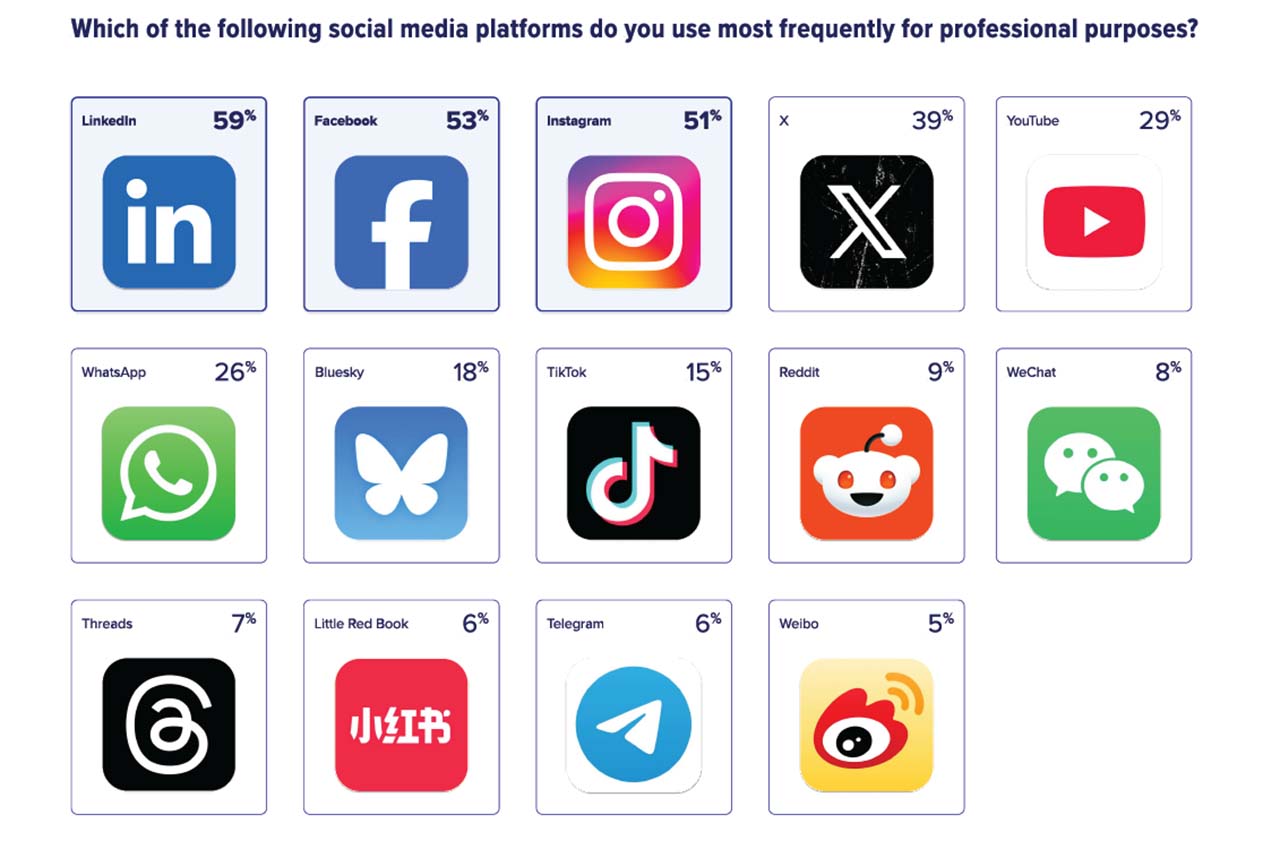
When it comes to journalist engagement, not all platforms are equal. Knowing where to concentrate your efforts matters. As our PR industry survey shows, LinkedIn occupies the first place globally, with 59% of respondents citing it as their most-used platform for professional purposes. Next is Facebook at 53% and Instagram at 51%.
You might’ve expected these to make it to the top three, but here’s an interesting development: Bluesky, which launched in early 2023, has quickly become a new favorite among journalists (18%), outranking even TikTok in adoption (15%). This gives you an opportunity to establish a presence on an emerging platform, where you can find less competition and more organic engagement, before it becomes mainstream.
Key takeaway: LinkedIn should still be your go-to platform for connecting with journalists. Maintain visibility on Facebook and Instagram as relevant to your industry, and take into consideration setting up a Bluesky profile, even if it’s just to claim your handle and monitor relevant discussion.
What are journalists using social media for?
How journalists use social media is especially relevant for PR pros – it can help them gather insights to and get to know what makes them tick. By looking at the data, we can see three core professional uses:
- 64% use social media to publish and promote their own content
- 55% use it to interact with their audiences
- 51% use it to crowdsource information and sources for stories
With more than half of journalists actively using social media to find sources and gather information, your presence on these platforms is not just to tell your brand’s story – it's a practical opportunity to position yourself as a resource for reporters. In the 2025 State of the Media Report, journalists shared some of the specific ways you can provide value. Here they are:
- Connect them with relevant resources (63%)
- Facilitate access to key people or places (57%)
- Provide relevant story ideas (43%)
- Give access to exclusive news or content (39%)
On the one side, journalists need stories, sources, and expert perspectives. On the other side, good PR teams provide access, position clients as experts, and flag relevant data. Social media is where these needs meet in real time, and that’s why you should take advantage of it.
How do you make yourself visible and useful?
Your priority on social media: Become the kind of PR and comms person journalists notice before they need something, so that when they do, you are already seen as a valuable resource. Here are a few tips for building that presence deliberately:
- Follow the journalists you’d like to establish a relationship with. Start by following the journalists most relevant to your industry. Read their content and what they share, pay close attention to the types of stories they typically cover, and notice how they engage with their audience. Use social media to gain real-time insight into journalists’ interests. This research will ultimately help improve your outreach – journalists are more likely to respond to pitches that are personalized to their specific coverage. This matters: 38% of journalists say pitching a relevant story idea is the best way to connect with them.
- Use #journorequest and #PRrequest. These hashtags – especially on X and LinkedIn – are among the most direct ways to spot pitch opportunities as they arise. Journalists usually post using #journorequest when they’re actively looking for sources, experts, or story leads. When you do get a positive mention, tag the journalist, and thank them. Similarly, on the PR side, you can use #PRrequest. Set up keyword monitoring for these tags on any platform where your target journalists are active.
- Add your own commentary and perspective. When sharing a journalist’s story or engaging with their content, don’t just repost it. Maybe you have a data point that supports their statement, a thought leadership piece that extends the story, a question worth exploring, or a counterpoint from your own experience. This positions you as an expert in the industry, not just a fan. Your goal is to build your online presence and become worth following. If a journalist sees value in your feed independent of any pitch, you are already ahead of the majority of PR contacts in their inbox.
- Acknowledge coverage when it comes. Whenever a journalist covers your brand favorably, acknowledge it on social media. Tag them and thank them. You can keep it brief and genuine – a simple one-line post that credits their work can go a long way toward making the relationship feel reciprocal.
What should you know about platform nuances?
Each platform has its own conventions, and treating them as interchangeable is a missed opportunity. Let’s see what each has to offer:
- LinkedIn: This is the professional default. It’s best for long-form insight, industry commentary, and establishing credibility over time. Here, the tone is more formal than on other platforms, and engagement tends to come from thoughtful comments rather than quick reactions. This is where relationship-building happens.
- Facebook & Instagram: Use these for softer engagement and audience research instead of journalist outreach. Facebook groups can be valuable in understanding how audiences are discussing certain industry topics, while Instagram is great for visual storytelling and reaching journalists who cover lifestyle, travel, fashion, food, or culture beats.
- Bluesky: This one’s still early, but this is why it’s worth investing in now. The platform’s smaller size means organic visibility is higher. Those journalists who use it are often more active and more approachable than they are on more saturated platforms. You’d be able to curate feeds relevant to your industry, while lacking the “noise” of X.
- Reddit: Only 9% of journalists are active on Reddit – but that’s okay. Reddit is not really about directly connecting with journalists, but more about surfacing the kinds of unfiltered conversations that can help spark new story ideas journalists haven’t spotted yet. Monitor relevant subreddits to identify emerging topics, audience pain points, and niche discussions that you can bring to a journalist as a tip or a lead.
- X: X still remains a core platform, with 39% percent of journalists using it. It’s where you can capture trending conversations in real time: Track breaking news, event commentary, and shifting sentiment as they unfold. X is also the place where you can find and follow industry experts, as well as catch #journorequests.
What tools and tactics can you use?
A dedicated social listening platform like CisionOne is the most efficient way to monitor journalist activity, track conversations, and identify opportunities across platforms in real time. But it’s not necessarily a must-have.
You can still get meaningful coverage at any budget level. Here’s what you can do if you don’t have a technology budget:
- Use the platforms’ search functions – LinkedIn, Bluesky, and X have search that can be valuable if you utilize specific keywords, hashtags, and filters by date.
- Use each platform’s analytics – social media platforms have their own native analytics functions that can help you track post engagement and give insight on your followers.
- Act on suggested follows and “people also follow” features – follow a journalist you know and platforms will surface similar contacts.
- Set up Google Alerts – think of key topics, industry trends, competitors’ names, and target journalists.
- Turn on platform notifications – follow journalists directly on their primary platforms and enable post notifications where possible, so you can see their posts as soon as they go live.
- Save your searches – most platforms allow you to save search queries; build a library of searches for your most-used keywords and check them as part of your media monitoring routine.
The best tool is a consistent routine. Make time daily to scan journalist activity, watch out for posts using #journorequest, and note down any stories worth engaging with. Real-time monitoring can help, but you can get valuable insights without it, too. You just need regular, deliberate effort.
Final thoughts
The numbers are clear: Journalists are active on social media, they use it to find sources and story ideas, and connect with experts in their industry.
But data alone can’t build genuine relationships. The PR pros who see the best results from social media aren’t those with the most followers or the highest posting frequency – they're the ones who show up with something useful to say, add authenticity to a conversation, and treat social media as a tool to build relationships, not just visibility.
Are you ready to use social media meaningfully and get real-time insights? Find out what Cision Social Listening can do for you by speaking with one of our experts.
Most Recent Posts
Cision Resources
-
E-books and Guides
Comprehensive how-to guides on strategy and tactics
-
Case Studies
What are other brands doing – and how can we learn from them?

About Bianca Parvu
Bianca is the Junior Copywriter at Cision, specializing in tech industry storytelling. She crafts engaging content across digital channels, from thought leadership to email marketing campaigns.