
The biggest opportunites PR teams can't afford to miss this year
Albert Einstein probably wasn’t talking about public relations when he said, “In the middle of difficulty lies opportunity,” but he may as well have been. Because today’s PR teams face no shortage of difficulties: Tighter budgets and leaner resources, faster news cycles, shifting audience behaviors, and rising expectations.... The list goes on.
But if findings from Cision’s Inside PR 2026 report are any indication: For every daunting challenge, an equally exciting opportunity awaits. From artificial intelligence to relationship building, the industry professionals surveyed for the report identified specific, actionable areas to help navigate the challenges they face, perform against rising expectations, and thrive in the year ahead.
Here’s what they had to say, what their answers reveal about where the industry is headed, and the steps your team can take to turn opportunity into real impact in the year ahead.
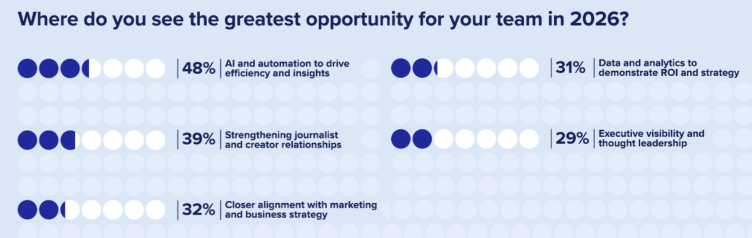
PR opportunity #1: AI and automation to drive efficiency and insights
Nearly half of all PR professionals who participated in the Inside PR 2026 survey (48%) selected AI and automation as the No. 1 opportunity for teams in 2026. This outlook likely stems from the pressure to “do more with less” – which emerged as one of today’s top PR challenges – calling for comms teams to work more effectively amid fewer resources. After all, the report also found that 93% of PR teams are leveraging AI tools to enable faster execution, deeper insights, and more time for strategy and creativity.
The widespread adoption of AI also signals a significant industry mindset shift: The question for PR is no longer ifAI belongs in their workflows, but where it works best and how to apply strategically.
How PR teams can take advantage:
To fully take advantage of this opportunity in 2026, PR teams should start by auditing their current workflows to identify where automation can have the greatest impact – particularly in areas that are time-intensive, repetitive, or heavily data-driven. With AI, teams can automate time-intensive tasks like media monitoring, media list building, performance analysis, and insight discovery, freeing up time for higher-value work.
Equally important is using AI with intention. Clear guidelines, training, and human oversight ensure these tools enhance (not compromise) credibility and trust. When applied strategically, AI and automation act as PR co-pilots, enabling teams to operate more efficiently while doubling down on what humans do best: Creative storytelling, relationship-building, and strategic counsel.
Start here: Check out The Complete Guide to Using AI in PR for tactics you can apply now to integrate artificial intelligence into your comms strategy.
PR opportunity #2: Strengthening journalist relationships
Nearly 2 in 5 PR professionals feel some of the greatest opportunity lies in “strengthening journalist and creator relationships.” The fact that this ranks second only to AI reinforces the notion that even as AI can make teams more efficient, human connection is still the ultimate competitive advantage.
Newsrooms are leaner than ever, and journalists are flooded with automated, low-quality outreach. The people who shape stories – reporters, newsletter writers, podcasters, niche creators – have more influence and less time, so they are gravitating toward partners who bring relevance, reliability, and real value instead of generic pitches. By focusing on relationship building, PR teams can go beyond securing coverage and gain credibility through trusted, third-party validation.
How PR teams can take advantage
The key to strengthening journalist and creator relationships in 2026 lies in taking time to understand them and personalizing your outreach. Start by connecting with journalists on their terms: Introduce yourself with a personalized email, a relevant story idea, or an invitation to an industry event so journalists begin to recognize your name. Media relationship management tools can be your best friend when it comes to helping identify relevant journalists, understanding their audience, their beat, their past work, and their preferred outreach channels – enabling even more personalized communication.
Follow and engage with brand-aligned journalists on social media, especially LinkedIn (most journalists’ preferred platform), to understand what they cover and build rapport before pitching. Offer value beyond pitches by connecting journalists with sources, providing multimedia assets, data, and access that help them tell stronger stories.
Finally – and this can’t be overstated – focus on relevance. Journalists can spot a generic email send a mile away and are quick to ignore it (the same goes for pitches that are purely promotional). Instead, tailor your pitches to match journalists’ audiences and focus areas; relevance significantly increases the chances a pitch will be read and acted upon.
Start here: Check out the 2025 State of the Media Report for insight into what journalists want, need, and expect from their public relations partners.
PR opportunity #3: Closer alignment with marketing and business strategy
One third of PR professionals feel that closer alignment with marketing and business strategy will be key to opening doors in 2026. It makes sense, given that PR is under growing pressure to demonstrate relevance to revenue, growth, and brand performance. Not to mention that there has been a long-time tension between PR and marketing, even as the commonalities between both outweigh the differences.
PR and marketing are most effective when they work together across key areas such as sales enablement, performance measurement, and unified messaging. So consider this an opportunity to collaborate on content and messaging to support sales efforts and move prospects through the funnel.
How PR teams can take advantage
Establishing shared and complementary metrics – such as earned media, share of voice, sentiment, SEO performance, and conversions – helps demonstrate impact and align priorities, while a unified brand story ensures consistency across marketing materials, websites, and social channels. Success depends on clearly defined roles and responsibilities, a shared commitment to using data from media monitoring and social listening to guide decisions, and regular communication to review results and refine strategies as messaging evolves.
Aligning around shared goals, insights, and storytelling can amplify one another’s impact, create stronger brand narratives, and deliver more meaningful business results.
Start here: Check our articles on How PR and Marketing Can Work Better Together and How PR Teams Can Think More Like Marketers (and Why They Should)
PR opportunity #4: Data and analytics to demonstrate ROI and strategy
Nearly one third of respondents see data and analytics as a major opportunity in the coming year, reflecting growing pressure tojustify budgets, influence decision-making, and connect communications efforts to real business outcomes. This aligns with broader industry trends showing that executives are both leaning more on PR for strategic counsel and holding them increasingly accountable to drive outcomes that have bottom line impact. Indeed, the right data and analytics can unlock numerous possibilities for PR – from better targeting and deeper understanding of audiences to securing bigger budgets.
This finding also signals a shift toward prioritizing measurement – and working as strategic business partners who can prove impact – as a core PR skill, on par with storytelling and media relations.
How PR teams can take advantage
To truly seize this opportunity, PR teams must move beyond vanity metrics and focus on insights that show how earned media, thought leadership, and campaigns support organizational goals like brand trust, demand generation, and risk mitigation. That means aligning measurement frameworks with executive priorities, using analytics to spot trends and inform strategy (not just report on past performance), and investing in tools and skills that make data easier to interpret and act on.
Teams that embrace data as a competitive asset – rather than a reporting requirement – will be better positioned to earn credibility, influence decision-making, and secure long-term investment in PR.
Start here: Check out The Complete Guide to PR Measurement for everything modern PR teams need to know about using data to show results, build strategies, and prove value.
PR opportunity #5: Executive visibility and thought leadership
According to our research, PR pros recognize that executive thought leadership is no longer a “nice to have” but a strategic asset. Nearly 3 in 10 PR pros see some of the greatest opportunities in increasing executive visibility and thought leadership, which aligns with the finding that brand awareness is the No. 1 overall priority for PR teams in 2026. This also makes sense given that consumer skepticism is at an all-time high, so establishing trust and credibility are critical for brands to thrive. PR leaders recognize that leading brands break through when executives – whose influence is increasingly integral to business success – are strategically positioned on the right stages.
How PR teams can take advantage
To capitalize on this moment, PR teams can start by building a scalable thought leadership strategy that positions executives as credible industry experts with distinctive and strong points of view. Use data from media monitoring and social listening to understand the topics your target audiences are most engaged with that executives can credibly “own,” as well as the channels and forums where their voices will resonate.
This intel can inform a content plan of resources like whitepapers and reports, blog posts, op-eds, and social media posts, which you can host on your owned channels or try to garner media coverage for. Pitch your executives to provide bylines in industry trades, appear on podcasts, and speak at industry events. Continue monitoring the conversation and tracking coverage to ensure leaders are consistently showing up where priority stakeholders are paying attention.
Start here: Check out Building an Effective PR Strategy: A Step-By-Step Guide, which covers how to use content, speaking, and thought leadership as part of a broader, measurable PR plan.
Emerging PR opportunities to watch in 2026 & what’s next
The opportunities ahead for PR certainly aren’t limited to these five. More than one in five PR professionals, for example, recognize building stronger partnerships with influencers and positioning employees as brand advocates as a way to extend reach and build credibility. A similar number see personalization as key to creating deeper, more authentic connections with audiences.
Others are experimenting with newer and evolving channels, such as podcasts and TikTok, to meet audiences where they already spend time. At the same time, a notable portion of PR pros recognize the growing importance of proactively controlling the brand narrative in an environment shaped by misinformation. The list goes on, and it is up to PR to decide which route to take on the road to success.
As the industry continues to evolve, the most successful teams will be those that actively explore new ways to create impact, rather than waiting for change to come to them. Whether that means experimenting with new channels, rethinking how audiences are engaged, or taking a more proactive role in shaping narratives, PR teams have ample room to innovate.
As that other famous saying goes, “If opportunity doesn’t knock, build a door.” In 2026, PR teams are well positioned to do exactly that.
Start here: For a deeper look at the current and future state of PR – and insights that can help inform the opportunities you pursue in the year ahead – explore the full Inside PR 2026 Report.

Most Recent Posts
Cision Resources
-
E-books and Guides
Comprehensive how-to guides on strategy and tactics
-
Case Studies
What are other brands doing – and how can we learn from them?

About Mary Lorenz
Mary Lorenz is Director of Content and Creative at Cision. She oversees the editorial strategy at Cision and writes about best practices and thought leadership for marketing, communications and public relations professionals. She has a background in marketing, public relations and journalism and over 15 years of experience in copywriting and content strategy across a variety of platforms, industries and audiences.