
AI is now firmly embedded in daily public relations workflows. From tools like media monitoring and sentiment analysis, to generative AI-driven press release creation, the technology has come a long way fast.
In fact, data from Cision’s Inside PR 2026 Report shows that a staggering 92% of PR teams use generative AI tools in their work. Further, 48% view using AI and automation to drive efficiency and insights as their biggest opportunity in 2026. Put simply, it’s no longer a case of if PR teams should use AI, but where and how they should deploy it.
Despite this technology-driven shift, the foundations of PR remain unchanged. Our same report reveals that storytelling and media relations are considered the two most in-demand skills for industry professionals this year.
Even as AI transforms how teams work, these findings make it clear: Authenticity remains at the core of PR. And though that may seem in direct contrast with AI-driven PR, it doesn’t have to be the case. Read on for practical strategies to help you strike the right balance between AI efficiency and human connection.
Why authenticity matters more than ever in PR
The rise of mis- and disinformation, deepfakes, and synthetic content has played a role in eroding public trust. And that’s a problem when trust is PR’s core currency.
Authenticity isn’t just important, it’s essential – a way to push back in a media landscape that’s becoming oversaturated by deceptive and malicious information. In this world, human authenticity stands out as a unique differentiator.
Audiences are also becoming increasingly adept at spotting fake or doctored content. “AI fatigue” is real. Reliance on AI content for brands could mean damaging reputation and standing. Another consequence for PR could be ignored pitches and damaged media relations if they rely too heavily on AI-generated outreach.
According to the 2025 State of the Media Report, 72% of journalists worry about factual errors in AI-generated press releases or pitches, while 58% say they worry that the volume of this content will increase but not the quality.
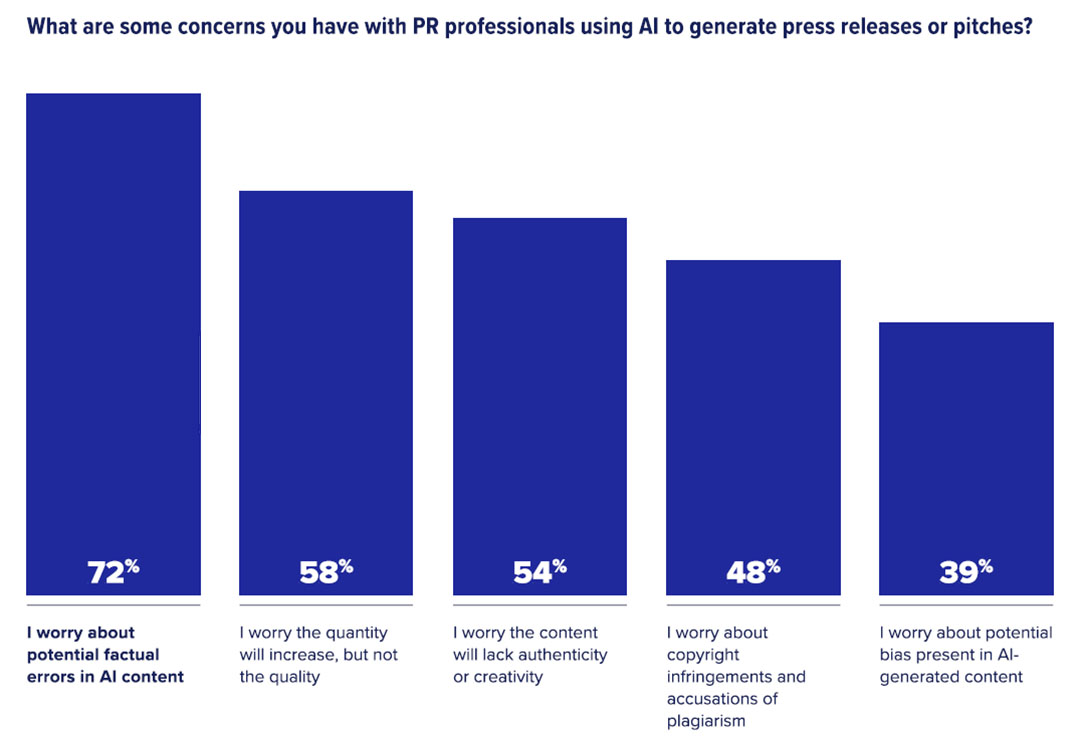
In addition, 78% say they will block a PR pro who spams them with irrelevant pitches. Reporters are inundated with emails and frustrated with mass, untargeted pitches, so thoughtful outreach that prioritizes relevance stands a better chance of securing earned media coverage.
AI can drive efficiency and create content at scale, but it can’t deliver true human insight and understand what makes a pitch truly relevant to a specific reporter and their audience.
The PR skills in demand in 2026
As mentioned, our research found that storytelling and content creation and media relations are the skills that matter the most to PR professionals this year.
Good PR campaigns work because they resonate with audiences on an emotional level and help shape perception in ways that benefit brands. AI can certainly assist in creating the content (and media outreach) that drives PR, but meaningful storytelling needs human insight into how an audience thinks and how to connect it to a brand’s goals and purpose.
PR pros also need to engage critical human skills to map out long-term strategy, crisis management, and make ethical decisions – all capabilities AI doesn’t possess. As AI expert Henry Ajder explained in a Cision webinar last year, AI systems are best thought of as prediction or “probabilistic machines.”
“They make a calculation based on the huge amounts of data they have been trained on about what is most likely to come next in a sequence, [based on] your prompt,” he explained. “If I say, ‘What color is grass?’, it will have learned based on the huge amount of data it's been trained on that the most likely word to follow in that sentence is going to be ‘green.’”
This set up makes AI perfect for processing information and identifying patterns, not for understanding context, acting on intuition, or bringing any lived experience to inform PR plans.
Even as AI outputs become more sophisticated, they still require human validation for accuracy, appropriateness, and strategic alignment. PR teams need to position themselves at each stage of the content process to steer the results to a place where they can be published.
How PR teams are currently using AI
PR has embraced AI across multiple use cases, and the Inside PR 2026 Report sheds light on just where the focus lies.
According to our research, the most popular use is for brainstorming ideas, named by 73% of respondents. Writing or refining content is second at 68%, followed by researching at 55%.
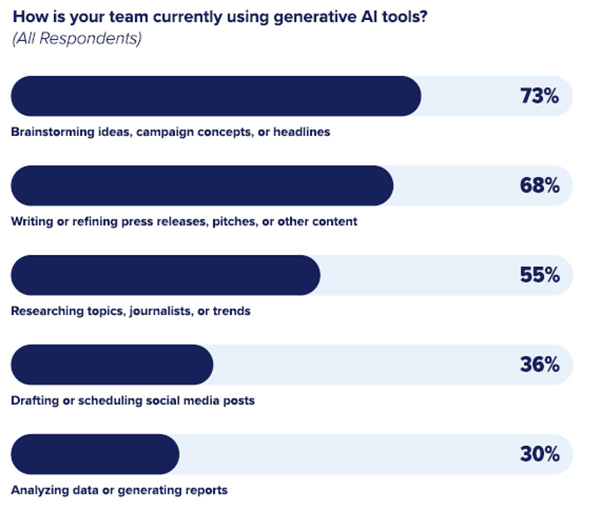
When this data is segmented by job seniority, those in senior position are more likely to use AI to write press releases, pitches, or content. This may be an indicator that they lean more on AI for the heavy lift of creating content to free up time to focus on more strategic work.
More stats that leap out: 80% of those at manager-level are using AI to brainstorm ideas and 60% using it for research on topics, journalists and trends. This skews higher than other job seniority levels.
With managers sitting on the front lines of PR and in operational roles (and resource-stretched), they’re using AI less for pure content creation and more to kick-start ideas and help speed up the process of undertaking time-consuming research.
For PR teams in 2026, any use of AI should start from the basis of supporting rather than diminishing authenticity.
How to balance AI and authenticity in PR
When creating content, think of AI as your starting point. The key to unlocking its benefits is to maintain human oversight at every stage of your content process. AI can bring value by aiding in...
- Creating first drafts of press releases and social media copy
- Brainstorming multiple headline choices and campaign angles
- Generating campaign messaging frameworks to spark creativity
- Overcoming blank-page, flashing cursor panic
Each piece of content you produce with AI needs thorough editing, refinement and approval from human eyes before you even think about making it public. Here are six points where you should step in:
- Check accuracy: Recent research found AI assistants make errors in news content
- Prioritize originality: Ensuring that AI outputs aren't plagiarizing previously published content
- Brand voice: Ensure tone and voice consistency across all comms
- Strategic alignment: Verify content supports campaign goals
- Cultural sensitivity: Review for contextual appropriateness
- Rework bland copy: Strip out generic language; AI models are known for overusing certain phrases
The real strength of AI comes when it frees up PR teams to do what they do best: craft compelling stories and build meaningful connections that strengthen reputation and trust. The technology already handles time-consuming manual tasks that can slow PR teams down, like real-time media monitoring, generating media lists, and summarizing lengthy reports.
The next step is to redirect that saved time into developing your creative skills and building deeper media relationships. When you're not buried in monitoring spreadsheets, you can have those in-depth conversations that lead to great coverage and long-term media partnerships.
Final thoughts
AI and authenticity shouldn’t be seen as opposing forces, but instead complementary. The teams that benefit will be the ones embracing AI as a tool for efficiency and scale, while doubling down on the human skills that have always defined great PR: Creativity, empathy, and relationship-building.
Authenticity and trust remain the foundation of effective public relations. As the media landscape becomes increasingly saturated with AI-generated content, your ability to build genuine relationships and communicate with honesty isn't just important, it’s critical to strengthening brand credibility, audience trust, and customer loyalty.
Find out how our AI-driven platform CisionOne can transform the way your PR team works. Speak with one of our experts.
Most Recent Posts
Cision Resources
-
E-books and Guides
Comprehensive how-to guides on strategy and tactics
-
Case Studies
What are other brands doing – and how can we learn from them?

About Simon Reynolds
Simon is the Senior Content Marketing Manager at Cision. He worked as a journalist for more than a decade, writing on staff and freelance for Hearst, Dennis, Future and Autovia titles before joining Cision in 2022.