
PR professionals have more tools at their disposal than ever. Tracking media coverage and social media conversations in real time are key to informing how they act, react, and form campaign strategies.
But there’s one question that media monitoring and social listening only answers partially: What is my audience actively searching for? This knowledge gap can be filled by search intelligence, which uncovers data on the questions being asked across traditional engines, social media, retail, and the outputs of AI platforms like ChatGPT and Claude.
The results can shape your next campaign launch or highlight an untapped topic your competitors haven’t spotted yet. With that in mind, here are five search metrics that belong on every PR dashboard.
Metric #1: Search volume – Are consumers searching for your brand online?
Tapping into search volumes across Google and Bing with brand-related keywords gives you visibility into the demand for your products or service, plus insight into category trends.
Knowing which relevant terms are rising and falling on traditional search platforms is only one part of the puzzle. Search bars on social media platforms such as TikTok and Pinterest are increasingly used by audiences for discovery, while search volume across retail destinations like Amazon gives a clearer picture of consumers in-market for product purchases.
Why it matters: Search volume in isolation can only tell PR teams so much. However, when mapped in relation to specific campaigns, it can illustrate if earned media coverage is translating into audience curiosity.
Plus, it can be a useful indicator of movement in topic interest in a related industry or sector. For example, a supermarket brand may see a sustained surge in search interest around sustainable food packaging and pivot to suppliers that can meet this customer demand.
Metric #2: Share of search – How does search volume compare vs. competitors and topics?
Just as share of voice is a key PR metric, share of search helps to benchmark your search volume against competitors or topics related to your brand. Over time, shifts in your percentage of total category share can be linked to the effectiveness of your PR activity (think a new product launch campaign or press announcements).
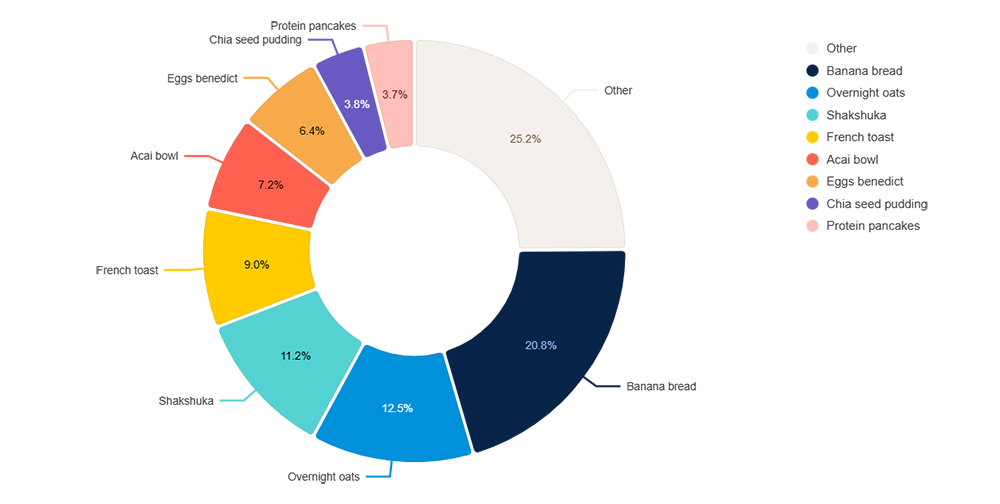
The chart below, taken from Cision’s Search Intelligence platform, shows share of Google Search volume using 19 search strings for different breakfast recipes (data is from UK region, November 2025 to April 2026). This share of search chart illustrates the popularity of banana bread and highlights potential content and promotional opportunities for FMCG retailers looking to capitalize.
Source: Cision Search Intelligence
Why it matters: Share of search volume shows if growing (or declining) audience interest around your brand, a certain product, topic, or a competitor is relative to the market, not just in isolation to your own measurement criteria.
Metric #3: AI mentions – How are you appearing in GenAI vs. competitors?
PR and earned media have long existed side-by-side. A well-timed press release can influence both media coverage and AI generated answers from the likes of Claude and ChatGPT, where people are increasingly turning for answers to brand-related questions.
That means PR professionals need to look beyond traditional brand mentions to AI mentions. In other words, how many times and in what context is your brand cited across ChatGPT, Gemini, Perplexity, and other LLMs (large language models) after relevant prompt queries? Tracking AI mentions also matters when a prompt should be surfacing your brand but isn’t.
Why it matters: It’s estimated that ChatGPT alone handles more than 2.5 billion queries per day. That’s a huge audience you could be missing out on. When relevant prompts surface competitors but not your brand, that can indicate an AI visibility gap that PR teams can influence through earned media and owned content.
Metric #4: AI sentiment – What is the tone of GenAI search results?
If your brand is public facing, there’s a good chance it’s being talked about and mentioned online. PR professionals have long relied on sentiment analysis to understand the tone (positive, negative, or neutral) of these mentions. Now there’s a need to expand this beyond traditional and social media and assess how GenAI search responses are framing your brand.
Bringing search intelligence into your PR strategy will allow you to track sentiment on AI outputs from platforms like ChatGPT, Claude, and Perplexity. This is particularly valuable following a campaign launch or comms crisis, helping you understand how your brand story is being told by LLMs.
Sentiment analysis should be treated as a directional indicator rather than a definitive measure, particularly for nuanced questions and mixed responses. However, it provides a useful benchmark for tracking changes over time and identifying emerging trends in how AI platforms portray your brand.
Why it matters: GenAI responses bring a new layer of brand understanding outside of traditional media and social conversations. They give PR teams a clearer picture of the narrative AI is telling consumers, who may be researching you on LLMs before they read a media article or engage with social content.
Metric #5: Share of LLM sources – Who is shaping the AI answers about your brand?
An LLM mentioning you is good, but being able to identify the publishers and outlets they’re drawing on when generating responses is even better. Share of LLM sources does exactly that. It measures which publishers, websites, and domains AI systems rely on most frequently when answering questions in your category.
Knowing which sources carry weight informs smarter targeting. If you can demonstrate that your media relationships and content investments are feeding into AI outputs, that’s a clear sign of strong LLM visibility.
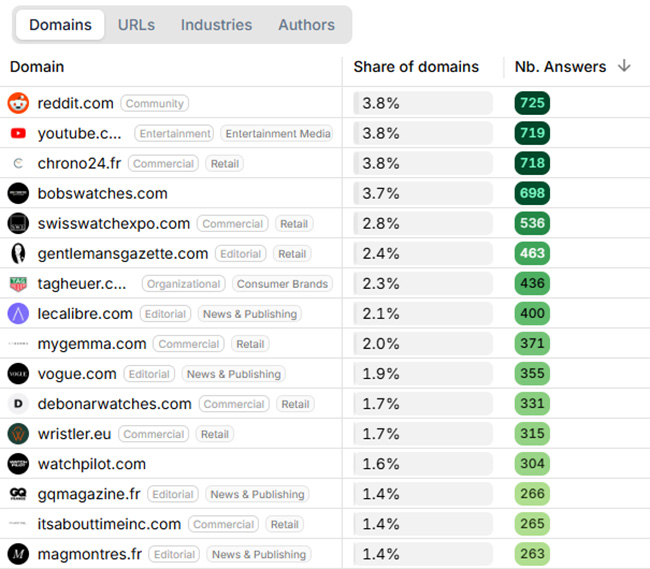
Take the below luxury watch example, created with 268 luxury watch prompts across six LLM models from April to June 2026. This shows the sources being cited in prompt responses – and gives PR professionals working across the luxury sector a guide to the channels and publications to target with outreach.
Source: Cision Search Intelligence
Why it matters: Earned media placements have traditionally been tracked by media monitoring tools. Now, the influence of earned media goes beyond human readers to shape how AI understands questions about your brand and sector. PR teams need to consider adding GenAI monitoring to their measurement toolkit or risk missing out on vital brand narratives.
The bottom line
Search demand combined with AI visibility and sentiment metrics give PR teams a clearer picture of unspoken audience intent forming and what they encounter across GenAI platforms.
As search journeys continue to splinter across traditional engines, social platforms, retail sites, and LLMs, PR teams that build search intelligence capabilities now will be better placed to understand, influence, and measure how their brand gets discovered.
Want to know what your audience is searching for? Find out how Cision’s Search Intelligence solution adds a missing layer to PR measurement.
Most Recent Posts
Cision Resources
-
E-books and Guides
Comprehensive how-to guides on strategy and tactics
-
Case Studies
What are other brands doing – and how can we learn from them?

About Simon Reynolds
Simon is the Senior Content Marketing Manager at Cision. He worked as a journalist for more than a decade, writing on staff and freelance for Hearst, Dennis, Future and Autovia titles before joining Cision in 2022.