
The Cision 2026 State of the Media Report has arrived, bringing PR professionals unmatched insight into how journalists work in a noisy media landscape. We surveyed more than 1,800 reporters across the globe to understand the biggest challenges they face, from tackling misinformation to the ongoing impact of AI on their profession.
The full 2026 report is available to download now, but if you’re looking for some fast takeaways – and relevant PR lessons – then we’ve brought together some of the topline findings.
1. 50% of journalists say misinformation is now their biggest challenge
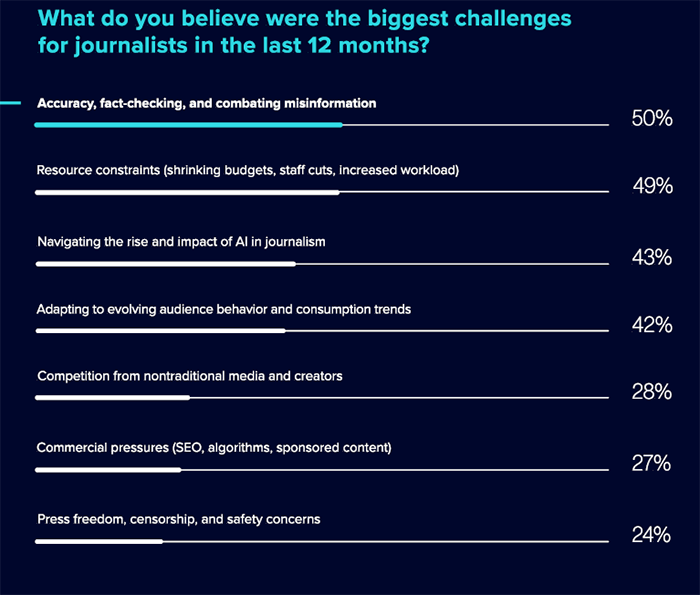
This year, reporters told us their biggest challenge was around accuracy, fact-checking, and combating misinformation. This was named by 50% of respondents, just ahead of the 49% who said one of their biggest obstacles was resource constraints (shrinking budgets, staff cuts, increased workloads).
Related to the above, 43% told us that navigating the rise and impact of AI on journalism was among their biggest challenges. That’s telling when AI is often cited as an amplifier of misinformation and a cause of job layoffs.
PR lesson #1: Journalists are desperate for credible information they can trust. PR teams that provide expert insights, original data, and solid sources are becoming increasingly valuable as newsrooms battle misinformation, layoffs, and AI-driven noise.
2. 48% of journalists use AI for brainstorming
The emergence of AI has left many in the media grappling with both its potential benefits as well as the negative impact it could have on their jobs. As noted, reporters view it as a major challenge, but 48% say they have used it for brainstorming ideas and 43% for research or fact-checking.
When asked how they feel about PR professionals using the technology, 21% say they are in favor with 53% opposed. That’s not a blanket “no,” but they voiced concerns around spam, low-quality writing, and a lack of personalization.
PR lesson #2: Accuracy and human oversight are essential when dealing with AI content. AI can assist PR pitches, but journalists still expect thoughtful human-centered outreach. Remember that creativity and authenticity lie at the heart of journalism – and many editorial staff have spent years developing subject matter knowledge that AI can’t replace.
3. LinkedIn overtakes Instagram and Facebook among journalists
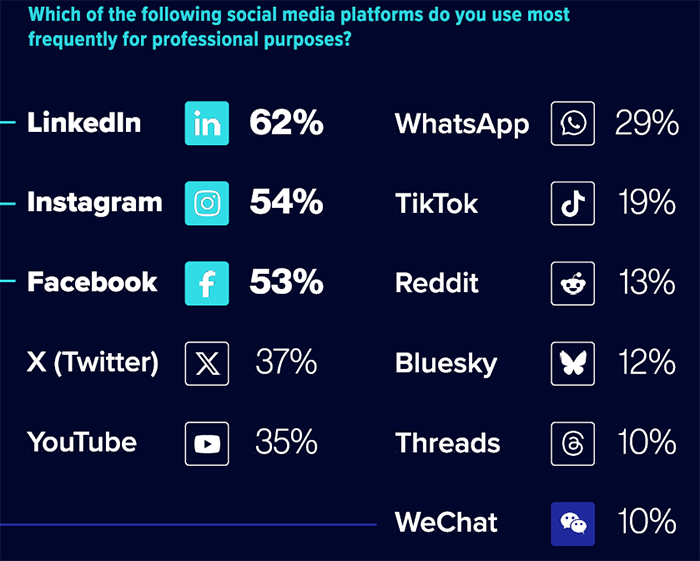
Ninety-seven percent of journalists we surveyed say they use social media for professional purposes, largely to publish or promote their own work. However, LinkedIn has emerged as the platform reporters are using the most for their work. These are the top three social platforms for usage:
- LinkedIn – 62%
- Instagram – 54%
- Facebook – 53%
These three occupied the top spots across both North America and EMEA regions. However, China is a big outlier in APAC with WeChat favored by 58% of journalists.
PR lesson #3: This insight provides a window into how journalists operate across social media, and where it’s possible to gather more information about what they publish, amplify, and show interest in. PR professionals should use this to their advantage, engaging with LinkedIn to research reporters they want to build relationships with.
4. Journalists receive 50+ pitches a week (and reject most of them)
A consistent theme that’s emerged across State of the Media surveys in recent years is relevance. That’s still true in 2026. Most journalists receive 50 or more PR pitches a week, yet the majority of them aren’t relevant to their area of coverage.
Further, a significant 86% of journalists say they will reject a pitch because the outreach lacks relevance to their audience or beat. Well-targeted outreach is what they want, with 79% saying they’re more likely to engage with a pitch that’s relevant to them.
PR lesson #4: Journalists are overwhelmed with pitches and relevance is the real deciding factor. Stats and exclusivity will help strengthen your outreach– 47% of reporters said their ideal pitch should include compelling data, while 45% wanted embargoed or early access information.
5. 84% of journalists are open to an introductory email
Journalists are so inundated with pitches and requests that making a connection might seem like an uphill task, but it is possible – and as our study found, most journalists are open to building relationships with PR professionals. (It just takes the right approach.)
The overwhelming majority of journalists (84%) said the best way to start building a relationship with them is simple: Introduce yourself via email, even without a story to pitch, and explain why you want to connect.
PR lesson #5: PR and journalism are both so fast-paced, it can be easy to get caught up in transactional and one-off interactions. If you can invest time in getting to know journalists as human beings, it’s a strong basis to build a relationship from.
The bottom line
These findings from the 2026 State of the Media Report highlight a clear message: Success relies on understanding journalists' evolving needs. As the media changes and new challenges appear, PR teams need to ensure they're providing reporters with relevant stories backed by compelling data. Thoughtfulness and personalization in your outreach should be your first step for lasting, mutually beneficial media relations.
While technology and platforms evolve, the fundamentals of public relations remain consistent – journalists want trustworthy partners who can provide valuable, audience-relevant content.
Find out how CisionOne can help you connect you with the right journalists to share your stories.
Most Recent Posts
Cision Resources
-
E-books and Guides
Comprehensive how-to guides on strategy and tactics
-
Case Studies
What are other brands doing – and how can we learn from them?

About Simon Reynolds
Simon is the Senior Content Marketing Manager at Cision. He worked as a journalist for more than a decade, writing on staff and freelance for Hearst, Dennis, Future and Autovia titles before joining Cision in 2022.